


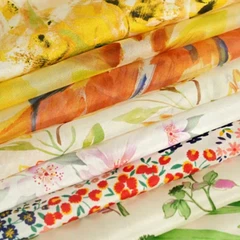
From the comparison of the printing process, digital printing, as a new printing method, will meet the increasingly diverse mid-to-high-end needs of the market with its advantages of high efficiency, low proofing cost, good printing effect, and less pollution.
Faced with increasingly severe environmental pressures, many printing and dyeing companies have turned their attention to digital printing with less pollution. In digital printing, the dye solution is directly packed in a special box and sprayed on the fabric on demand, which is neither waste nor waste water pollution. It eliminates the dye solution discharged from the printing machine in the slurry room and achieves no pollution in the printing process. Film is also omitted. Material consumption such as wire mesh and silver tube. It not only reduces the burden on enterprises, but also fulfills the requirements of environmental protection. The emergence and continuous improvement of this technology has brought a brand new concept to the textile printing and dyeing industry.
Relevant figures show that when using traditional printing equipment for printing, about 30% of the amount of dye cannot be combined with the fiber, and will be washed away during washing to cause pollution; while the digital printing process uses the ink direct injection process, and the amount of dye is only the traditional 40%. About %, and only 5% of the ink is washed away during post-processing, and the amount of pollution produced is only 1/15-1/25 of the traditional printing process. It is precisely because the digital printing machine has the advantages of convenience, speed, and environmental protection, the demand for digital printing by printing and dyeing enterprises is increasing year by year.
In addition, although the current cost of digital printing is still 2 to 3 times that of traditional printing, the investment income of digital printing is 3.5 times higher than that of traditional printing.
The national "Thirteenth Five-Year Plan" puts forward higher energy-saving and emission reduction requirements for the printing and dyeing industry, and digital printing has become a trend in the printing industry.
At present, the printing and dyeing industry in the five eastern provinces of China accounts for 90% of the national printing and dyeing industry, and these regions are facing environmental protection challenges. Digital printing has given birth to changes in the industry, which will restructure the industrial distribution, gradually affect the new management system and marketing model, and force technological innovation.
Overall, the future of the digital printing industry is worth looking forward to!