


The difference between knitted denim and woven denim is firstly distinguished from the perspective of dyeing. The yarn used in woven denim needs sizing, while the yarn used in knitted denim does not need sizing.
From the selection of raw materials, the yarn used for knitted denim has relatively low twist and high cotton content, while the yarn used for woven denim has higher twist and the requirements for cotton blending are often slightly lower.
If it is used for weft or weaving, knitted denim yarn can be used on woven fabrics, but woven denim yarn cannot be used directly on the machine, because too much twist will easily cause fabric defects. The large twist causes the overall weft skew to exceed the standard, which is not conducive to the cutting and sewing of clothing, resulting in serious adverse consequences such as twisted legs.
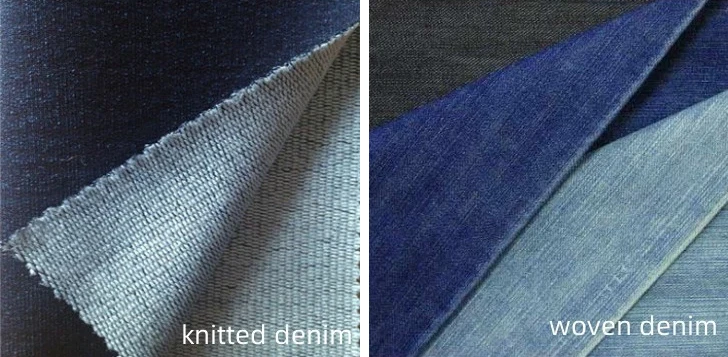
Difference Between Woven and Knitted
Difference 1: The organizational structure of the fabric
Knitting is the sequential bending of yarns into loops, which are interwoven to form a fabric. Woven weaving is formed by interweaving two or more groups of yarns perpendicular to each other at a 90-degree angle. The longitudinal yarns are called warp yarns, and the horizontal yarns are called weft yarns.
Difference Two: Physical Mechanics
The physical and mechanical properties of knitted fabrics are very good, including longitudinal density, transverse density, square meter weight, elongation, elasticity, breaking strength, coverage, and bulk density. The physical and mechanical properties of woven fabrics only include the yarn density of warp and weft yarns, selvage, front and back wool directions, front and back wool directions, fabric coverage, etc.
Difference 3: The basic unit of fabric organization
The smallest unit of knitted fabric is a loop. The coil consists of a coil rod and an extension of the space curve. The smallest unit of a woven fabric is a weaving point, that is, every point of intersection between warp and weft.
Weaving is the process of forming yarns into loops, which can be done horizontally or vertically. Horizontal weaving is called weft knitting, and longitudinal weaving is called warp knitting. Weaving is divided into two categories: hand weaving and machine weaving. Hand-knitting uses stick needles. It has a long history, exquisite craftsmanship, and flexible flower shapes. It has been widely spread and developed among the people.