


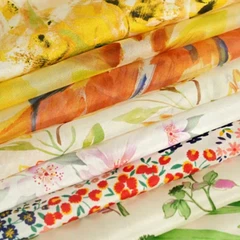
The difference between reactive printing and pigment printing
There are two main methods of fabric printing, one is traditional reactive printing and the other is pigment printing.
Reactive printing is a chemical reaction that occurs through the penetration of dyes into the fibers, so that the dyes and fibers form a whole. Pigment printing is a printing method that physically combines dyes with fabrics through adhesives.
The difference between reactive printing and pigment printing is that reactive printing has a smooth and soft feel. As the saying goes, reactive printed fabrics look like mercerized cotton, and double-sided printing is very effective; and pigment printed fabrics have a hard feel and look a bit like ink painting. .
First, the characteristics of pigment printing
The process is simple and the cost is low, but the color fastness is poor, and the color becomes old after washing; no softener is added, it looks very hard.
2, the characteristics of active printing
Good air permeability, good color fastness, soft hand feel, but the process is long and difficult, environmentally friendly, the color and fabric feel are also better, and there will be no hard feel.
3. Identification method
Know the color: Pigment printing is not bright in color, and the color is dull, giving a feeling that the color is floating on the surface of the fabric. Like a layer of painting on the wall.
Odor: Pigment printing has added a lot of adhesive and has not been washed with water, so the finished fabric will have a strong odor.
Handfeel: Pigment printing has a hard handfeel, and a softener needs to be added when setting, and the handfeel is softer.
Our fabrics can be printed by different methods;
Digital printing: especially suitable for small batches, rich color requirements, high-quality printing effects.
Reactive wet printing: specially used for cotton fabrics, rayon/viscose fabrics, bamboo fabrics, modal fabrics, etc.
Dispersion wet printing: special for polyester fabrics.
Acid wet printing: special for nylon fabric and acrylic fabric.
Pigment printing: especially suitable for blended fabrics, such as cotton/polyester blends, polyester/rayon blends, etc.