


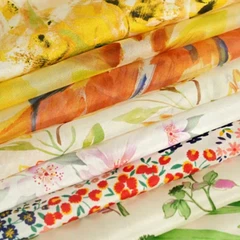
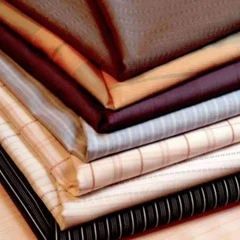

Printed fabric is a common fabric, and its production process involves multiple steps. The following is its general production process:
I. Raw material preparation
1. Fiber selection
- First, determine the type of fiber to make the fabric. Common fibers include cotton, polyester, silk, linen, etc. For example, cotton is a widely used natural fiber that has the advantages of softness and breathability, and is suitable for making daily wear clothes and household items. Polyester is a synthetic fiber that has the characteristics of wear resistance and wrinkle resistance, and is often used in the production of sportswear and functional fabrics.
2. Yarn production
- After selecting the fiber, the fiber needs to be spun into yarn. This process is carried out in a spinning mill, where short fibers or filaments are twisted into yarn through a spinning machine. Parameters such as yarn thickness and twist will affect the appearance and performance of the final fabric. For example, yarn with high twist may make the fabric more stiff, while yarn with low twist may make the fabric softer.
2. Fabric Weaving
1. Weaving Methods
- There are many weaving methods that can be used to make fabrics, such as weaving, knitting and non-woven. Weaving is one of the most common methods, which forms fabrics by interweaving warp and weft yarns. For example, plain weave is the simplest woven weave, in which the warp and weft yarns are interwoven alternately one above and one below, making the fabric structure tight and flat. Knitting is formed by the mutual interweaving of coils, and knitted fabrics have good elasticity.
2. Fabric Pretreatment
- Before printing, woven fabrics usually need to be pretreated. This may include steps such as desizing, scouring, and bleaching. Desizing is to remove the sizing added to the fabric during the weaving process, scouring can remove natural impurities and residual sizing, and bleaching is to improve the whiteness of the fabric and provide a good base color for subsequent printing.
3. Printing Process
1. Printing Preparation
- Design the printing pattern: First, the designer needs to design the desired printing pattern, which can be floral, geometric, abstract, etc. These patterns can be completed by hand-drawing, computer-aided design (CAD), etc.
- Make a printing plate: Make a printing plate according to the designed pattern. Common printing plates include screen printing plates, roller printing plates, etc. For example, the screen printing plate is made by making transparent parts of the pattern on the screen. When printing, the pigment is printed on the fabric through these transparent parts.
2. Printing method
- Direct printing: This is the most common printing method, and the printing paste is printed directly on the fabric. For example, direct printing is performed using reactive dyes, which can react chemically with fabric fibers to firmly attach the color to the fabric.
- Resist printing: First print a resist on the fabric, and then dye it. The part with the resist will not be dyed, thus forming a pattern.
- Discharge printing: The fabric is first dyed, and then a discharge agent is printed. The discharge agent will destroy the dye in the dyed part, thus forming a pattern.
IV. Finishing
1. Cleaning and fixation
- The printed fabric needs to be cleaned to remove the unfixed dyes and auxiliaries. After cleaning, fixation treatment is also required to improve color fastness. For example, for fabrics printed with reactive dyes, color fixation can be performed by steaming and other methods.
2. Softening Finishing
- To improve the feel of the fabric, softening finishing is performed. This can be achieved by adding softeners, which can make the fabric surface smoother and softer.
3. Other Finishing
- Depending on the purpose of the fabric, functional finishing such as waterproof, oil-proof, and antibacterial may also be performed. For example, for fabrics used in outdoor clothing, waterproof finishing can be performed to make it waterproof.
Through the above steps, a beautiful printed fabric is made.