


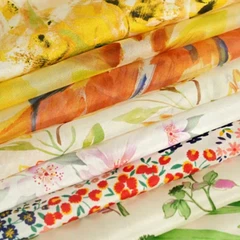
There is nothing more beautiful than a colorful printed fabric on a table.
Creating and printing beautiful patterns and patterns on different fabric materials is called textile printing. Drawing patterns and designs by hand consumes time, effort and cost. Also, repeating the same design on fabric by hand is difficult to achieve perfection. Textile printing is an ancient art with a long history in various parts of the world. Over time, textile printing technology has undergone an evolution from manual printing to automatic digital printing. Today in this blog we will share amazing traditional and modern textile printing techniques that are still in use.
There are three common processes in textile printing. They are direct printing, discharge printing and resist printing.
• The process of printing directly onto fabric with colored dyes and chemicals is called direct printing.
• Discharge printing refers to the removal of specific colors from printed fabrics and the use of suitable chemicals.
• By using resist paste on colored fabrics, staining will only occur in areas unaffected by the resist adhesive. This process is called resist printing. This is the main process of printing.
We will now take a closer look at traditional and modern methods of fabric coloring.
1. Block printing Block printing is the oldest technique, originating in Egypt or Persia. Many also believe that the art of woodblock printing developed in East Asia and later spread further to European countries. Block printing was first performed on calico, linen, and of course wool. In addition, red dyed cotton from Turkey was used for block printing. On a piece of wood, the desired design is hand carved and will be used to form the pattern. Use different blocks according to design, color and print size. To create special effects and details, such as birds or flowers, strips of copper are hammered into the blocks. These blocks use pitch pins to ensure the color applied to the fabric is accurate. Apply the ink paste to the block and press firmly against the cloth. Each block is arranged and repeated in a unique way, making the fabric look beautiful in one large continuous design.
2. Roller printing Roller printing is also called roller printing or rotary printing. This is the most common method of printing textiles around the world since the mid-19th century. The method involves passing the fabric through a continuously rotating drum and pressing it into the drum. The cylinders are carved with intricate and delicate patterns, leaving imprints of different colors on the textile. Cylinder printing improved and began to produce fabrics in brighter, lively colours. The process is also made faster as it can print a large number of garment prints in a single day. Subsequently, the dyed fabric is subjected to a steam washing and drying process that allows the color to penetrate into the textile.
3. Advances in digital printing technology are advancing every day. With the advancement of the textile industry, digital printing came into being. It's all about using the desired printing technology on the material. It's cost-effective, unique and very fast. Printing houses use computers to capture prints on fabric. What's more, you can use any fabric for your design. Polyester, linen, cotton, silk, rayon, blended and many other options. Digital printing uses inkjet technology. It's a bit pricey, but it prints out great. A heat press or tunnel dryer will help dry the dye on the cloth. Digital printing uses acid, reactive or pigment based inks. Acid and reactive inks are used on natural and man-made fibers, and printed fabrics require a steaming, washing and drying process. This requires large amounts of water, steam and energy, and produces waste water. Pigment-based inks are environmentally friendly and can be used to print on knitted and woven cotton, linen, rayon, silk, polyester, nylon, blended materials. It does not require steaming and washing processes, so it is very cost-effective and environmentally friendly. Overall, you can get excellent quality garments with digital printing.
4. Screen printing Screen printing is one of the most popular ways of textile printing. T-shirts that are sometimes seen on the street are printed using a screen printing process. This is a direct-to-fabric printing process that uses films, meshes and screens to create a pattern on the fabric. Flatbed screen printing and rotary screen printing are two types of screen printing. The former is expensive, while the latter is widely used in the textile industry. The screen is formed from a piece of grid stretched over the frame. Later, patterns were formed by shading parts of the screen. With the help of the grid, the ink is pushed onto the textile below the screen. This printing requires one color per screen, which can lead to higher costs. With screen printing, you'll also get a durable, high-quality design. Screen printing is perfect for those who run a clothing business and want to have the same design printed on many garments.
5. Spray printing As the name suggests, spray printing is done through a sprayer. It will help diffuse the color onto the textile. Spray gun is an essential equipment for painting. Also, experiment with different sprayer nozzles to get the look you want.
6. Sublimation transfer printing For sublimation transfer printing, you need inkjet or color laser printer, sublimation ink and heat press machine will help you transfer sublimation dye to fabric. This method is more expensive than all of the above, but what you will get in return is vibrant and beautiful. The disadvantage of sublimation transfer printing is that the pattern cannot be obtained on cotton fabric. Good for this print are polyester and synthetic fibers. Another great thing about Sublime prints is that they are durable and last a long time. But if stored for a long time or exposed to sunlight, the color may fade.
7. Stencil printing As the name suggests, stencil printing refers to cutting a stencil into a pattern shape. These stencils are made from metal, wood, plastic and paper. The dye is then applied to the space cut out from the inside of the template. It's a safe method of printing that kids can do easily too. The downside of this method is that it takes a long time to print. So one can make it for home use or just for fun.
8. Heat Transfer Printing One of the cheapest methods of printing on fabrics is heat transfer printing. It utilizes a printing press and a heat press to transfer the pattern onto the fabric. First, in this process, the print is printed on paper, then transferred to fabric, and then the designed fabric goes to heated rollers. In this method, the color may disappear after the first wash. However, because of its clear and beautiful patterns, many institutions use thermal transfer printing. Colors always brighten our mood. Even more interesting is the difference in coloring methods. Since ancient times, there have been various methods of coloring fabrics.