


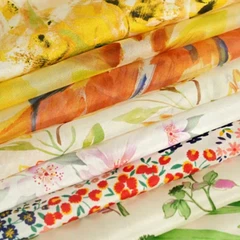
To be "outstanding" in fabric printing, you must be familiar with these 8 types of clothing printing techniques
There is a saying that goes like this: "Look at colors from a distance, and see flowers from up close." This shows the importance of printing to clothing. How are the prints on clothes made?
01.Taiwan printing
Table printing, also called screen printing, is a very traditional printing process. The basic principle is: part of the mesh of the screen printing plate can pass through the ink and leak onto the substrate; the rest of the mesh on the printing plate Blocked, ink cannot pass through.
Table printing is suitable for concrete patterns with clear edges and bright colors. Patterns printed with Taiwan plates need to be color separated before printing, that is, the colors to be used are separated. For each tone, the workshop will produce a pattern engraved with the printing pattern.
Hermès silk scarves are printed using a Taiwan printing plate. The picture below shows the production process of Hermès silk scarves. Let’s experience it together~
02.Digital printing
Digital printing is to input the pattern into the computer in digital form, edit and process it through the computer printing color separation and drawing system (CAD), and then the computer controls the micro-piezoelectric inkjet nozzle to directly spray the special dye liquid onto the textile to form desired pattern.
Compared with traditional printed fabric patterns that follow the repetitive combination of unit shapes, digital printing breaks through the restriction of the cyclic arrangement of unit patterns. The size of the repeating units can also be determined freely, and the concept of fabric edges can be ignored within a certain range.
This kind of design freedom allows designers to give full play to their innovation capabilities, become more creative in pattern composition and expression, and brings new creative entry points to designers in the application of clothing fabrics.
02.Transfer printing
Transfer printing began in the late 1960s as a textile printing method. The initial transfer printing first prints a certain dye on paper and other materials, and then uses heat pressing to transfer the pattern to the fabric.
As transfer printing technology matures, two modern processes, gravure heat transfer printing and digital heat transfer printing, have emerged.
Transfer printing is a more economical and efficient printing method that can achieve strong three-dimensional effect, fine patterns, delicate layers, lifelike patterns and strong artistry.
The temperature, time and pressure required for printing transfer will cause discoloration of the garment fabric. In order to avoid fabric color difference caused by transfer printing, it is not advisable to transfer printing immediately on garments that have just been ironed. You need to wait for the moisture in the garment to evaporate and dry before printing.
03.Water slurry
The so-called water slurry is a kind of water-based slurry. It does not feel strong when printed on clothes, and its covering power is not strong. It is only suitable for printing on light-colored fabrics, and the price is relatively low. Watermarks will not affect the original texture of the fabric and are very breathable, so they are more suitable for large-area printing patterns.
04.Offset printing
The emergence and widespread use of glue after water slurry, because of its very good coverage, allows dark clothes to be printed with any light color, and has a certain gloss and three-dimensional effect, making the clothes look more high-end , more textured. However, the glue has a certain hardness and thickness, and its disadvantage is that it falls off easily, making it not suitable for large-area use. In general, the water slurry process can be used on a large area, and the glue can be combined with the water slurry process to embellish the pattern.
Generally speaking, glue printing is more commonly used, such as leisure brands such as "Yichun" and "Senma".
05. Discharge printing
Discharge printing is carried out in two steps. In the first step, the fabric pieces are dyed into a solid color. In the second step, the pattern is printed on the fabric. The printing paste in the second step contains strong bleaching agents that can destroy the background dye. Therefore, this method can produce floral cloth with a blue background and white dot pattern. This process is called whitening. Discharge printing is possible when bleach is mixed in the same paste with dyes that do not react with it (vat dyes are of this type).
06. Resist dye printing
Chemical agents or waxy resins that can block or prevent dyes from penetrating into the fabric are printed on white fabric. The purpose is to dye the background color to bring out the white pattern. Note that the results are the same as for discharge-printed fabrics, however the method of achieving this result is the opposite of discharge printing.
Because discharge printing and resist printing produce the same printing effect, they often cannot be distinguished through naked eye observation.
07.Reduction printing
This process takes advantage of the differences in chemical corrosion resistance of different fibers in interwoven or blended fabrics, and uses a printing method to apply a burning agent to partially remove one of the fibers on the fabric, leaving the other fibers to form a translucent pattern. Also called burn-out printing or burnout printing.
08.Shrink print
The printing method is used to locally apply chemicals that can expand or shrink the fibers on the fabric. Through appropriate treatment, the fibers in the printed parts and the fibers in the non-printed parts will have a difference in puffing or shrinkage, thereby obtaining products with regular concave and convex patterns on the surface. Such as pure cotton printed seersucker using caustic soda as bulking agent. Also called embossed printing.
The temperature is generally 110C, the time is 30 seconds, and the 80-100 mesh screen is used for printing.