


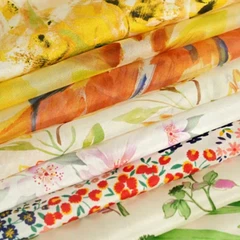
Pure cotton direct-injection printing belongs to a material description of printing, while reactive printing belongs to a process description of printing.
Pure cotton direct-injection printing means that the designed artwork is converted into digital form and transmitted to the computer, edited and processed by the computer printing and color separation drawing system, and then the computer controls the micro-voltage nozzle to directly spray the proprietary ink to the pure ink. On the cotton fabric, the original pattern is formed after the colors are mixed. (Through the color management system to adjust the curve, you can achieve perfect color conversion, what you see is what you get) Direct injection process on pure cotton materials can use reactive ink, disperse ink, paint ink, etc.
Coating ink is the use of tiny pigment particles to show color on the surface of the fiber, and it forms a film on the surface of the fabric by bonding with an adhesive. The color and color fastness on pure cotton are not as good as other inks. At present, the fluency is relatively good because the dispersion ink of DuPont and other companies is mainly composed of disperse dyes, dispersants, co-solvents, and deionized water. It is mainly used for digital inkjet printing of synthetic fiber fabrics such as polyester and nylon.
At present, dispersed direct injection is also applied to pure cotton direct injection. The representative products of commercial dispersion inks currently on the market are mainly from companies such as Wan Linglong. The reactive inks are mainly composed of salt-free or low-salt high-purity reactive dyes, co-solvents and deionized water. They are suitable for cellulose fibers, silk and wool. Inkjet printing of other fabrics. It is a process that relies on the active groups in the ink to react with cellulose fibers to form a color.