


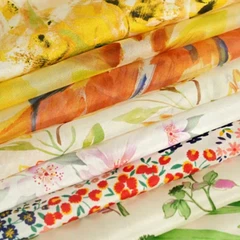
Printing technology has solved the problem of pure color cloth without printing before, greatly enriched people's material life enjoyment, loved by people. Here, we will talk about the following traditional printing technology.
1. Screen printing
Screen printing includes the preparation of screen printing. The screen used in the printing process was once made of fine silk. The process is called screen printing. The screen fabric is coated with an opaque, non-porous film. Where there is a pattern, the opaque film should be removed, leaving a screen with fine mesh. This area is where the pattern will be printed.
Most commercial screen fabrics are first coated with a layer of photosensitive film, and then through the photosensitive method to remove the thin film of the pattern and show the pattern. Print by placing a screen on the fabric to be printed. Pour the paste into the print frame and force it through the mesh of the screen with a scraper (a tool similar to the windscreen wiper on a car). Each color in the print requires a separate screen for the purpose of printing different colors separately.
2. Manual screen printing
Hand-made screen prints are commercially produced on long platens (platens up to 60 yards long). The printed cloth rolls are spread smoothly on the platform, and the surface of the platform is precoated with a small amount of sticky material. The printer then continuously moves the screen frame by hand along the entire table, one at a time, until the fabric is finished. Each screen frame corresponds to a printing pattern. This method produces at a rate of 50-90 yards per hour. Commercial manual screen printing is also widely used to print cut pieces of clothing. In the garment printing process, the garment making process and the printing process are arranged together.
Custom or unique designs are printed on the pieces before they are sewn together. Because manual screen printing can produce large mesh frames for large floral patterns, it is also possible to print fabrics such as beach towels, novelty printed aprons, draperies and shower curtains. Hand-made screen printing is also used to print limited, highly fashionable women's clothing and small quantities of products for launch into the market.
3. Rotary screen printin
Circular screen printing differs from other screen printing methods in several important respects. Circular printing, like the drum printing described in the next section, is a continuous process in which the printed fabric is conveyed through a wide rubber belt to the bottom of a circular mesh tube in constant motion. Among screen printing, circular screen printing has the fastest production speed, which is more than 3500 yards per hour. Use seamless perforated metal or plastic mesh. The largest mesh circumference is greater than 40 inches, so the largest flowback size is greater than 40 inches. Rotary screen printing machines with more than 20 color sets have also been produced, and this method is slowly replacing roller printing.
4. Heat transfer printing
The principle of heat transfer printing is somewhat similar to transfer printing. In heat transfer printing, patterns are first printed on paper with disperse dyes and printing inks, and then the printed paper (also known as transfer paper) is stored for use by textile printing plants. In fabric printing, the transfer paper and the unprinted paper are attached face to face by a heat transfer printing machine, and the dye on the transfer paper is sublimated and transferred to the fabric at about 210 °C (400T), completing the printing process without further treatment.
The process is relatively simple and does not require the specialized knowledge necessary for the production of drum or screen printing. Disperse dyes are the only dyes that sublimate, and in a sense the only dyes that can transfer heat, so the process can only be used on fabrics composed of fibers that have an affinity for such dyes. Including acetate fiber, acrylonitrile fiber, polyamide fiber (nylon) and polyester fiber.
5. Jet printing
Jet printing is to spray small droplets of dye and stay on the precise position of the fabric. The nozzle used to spray the dye and pattern formation can be controlled by computer, and complex patterns and precise pattern cycles can be obtained. Jet printing eliminates delays and cost increases associated with carving rollers and making screens, a competitive advantage in the fast changing textile market.
Jet printing systems are flexible and fast, moving quickly from one pattern to another. Printed fabrics are free from tension (that is, no distortion caused by stretching) and the surface of the fabric is not rolled, eliminating potential problems such as flapping or fleecing. However, this process does not allow for the printing of fine patterns with blurred Outlines. Jet printing is now almost used for carpet printing, not an important process of clothing textile printing. However, thanks to the research and development of mechanical and electronic control technology, this situation may change.