


Why Choose Us
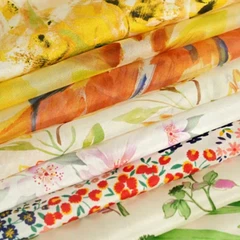
Our company having been specialized in digital printing, pattern designing, colour separating and mass production for many years. Our products have been exported to more than 50 countries/regions and we have won a great reputation both at home and abroad.
Quality
We are committed to providing our clients with top-quality dyeing services. We use only the best materials and techniques to ensure that your fabrics come out looking vibrant and true to color.
Expertise
Our team of dyeing professionals has years of experience in the industry. We have the knowledge and skills needed to help you achieve your desired results.
Variety
We offer a wide range of dyeing services to meet the needs of our clients. Whether you need to dye a small amount of fabric or a large batch, we have the resources to get the job done right.
Sustainability
We are committed to reducing our impact on the environment. We use eco-friendly dyeing techniques and strive to minimize waste throughout the dyeing process.
-
![Floral Print Silk Fabric]() Floral Print Silk FabricItem No.:MX203057. Material:Silk. Thickness:Light Weight. Pattern:Digital print / Screen print. Yarn count: 8mm. Width:135CM. Weight:34gsm. Use: Garment, Skirt,Dress, Sleepwear ,Shirt.read more
Floral Print Silk FabricItem No.:MX203057. Material:Silk. Thickness:Light Weight. Pattern:Digital print / Screen print. Yarn count: 8mm. Width:135CM. Weight:34gsm. Use: Garment, Skirt,Dress, Sleepwear ,Shirt.read more -
![Fashion Camouflage Printed Chemical Fiber Fabric]() Fashion Camouflage Printed Chemical Fiber FabricItem No.:MX203163. Pattern:Screen Print. Thickness:Light Weight. Material:100%P. Yarn count:50D*50D. Width:148CM. Weight:70gsm. Use: Garment, Skirt, Jacket, linging.read more
Fashion Camouflage Printed Chemical Fiber FabricItem No.:MX203163. Pattern:Screen Print. Thickness:Light Weight. Material:100%P. Yarn count:50D*50D. Width:148CM. Weight:70gsm. Use: Garment, Skirt, Jacket, linging.read more -
![Flower Printing On Fabric]() Flower Printing On FabricItem no.:MX203319. Composition:25%S75%R. Supply Type:Make-to-Order. Type:Organza Fabric. Pattern:Printed. Style:Plain. Yarn Count:19mm. Weight:81Gsm. Width:132cm. Use: Costume, Dress, Curtain, Homeread more
Flower Printing On FabricItem no.:MX203319. Composition:25%S75%R. Supply Type:Make-to-Order. Type:Organza Fabric. Pattern:Printed. Style:Plain. Yarn Count:19mm. Weight:81Gsm. Width:132cm. Use: Costume, Dress, Curtain, Homeread more -
![Floral Material for Dresses]() Floral Material for DressesItem no.:MX203264. Material:Silk. Composition:100%S. Thickness:lightweight. Supply Type:Make-to-Order. Printing Type: Printing. Style:Plain. Yarn Count:16mm. Weight:69gsm. Width:140CM.read more
Floral Material for DressesItem no.:MX203264. Material:Silk. Composition:100%S. Thickness:lightweight. Supply Type:Make-to-Order. Printing Type: Printing. Style:Plain. Yarn Count:16mm. Weight:69gsm. Width:140CM.read more -
![Boho Floral Fabric]() Boho Floral FabricItem no.:MX203091. Composition:52%V48%R. Thickness:lightweight. Feature:Organic, Sustainable. Supply Type:Make-to-Order. Type:Organza Fabric. Pattern:Printed. Weight:152gsm. Width:142cm. Use: Dress,read more
Boho Floral FabricItem no.:MX203091. Composition:52%V48%R. Thickness:lightweight. Feature:Organic, Sustainable. Supply Type:Make-to-Order. Type:Organza Fabric. Pattern:Printed. Weight:152gsm. Width:142cm. Use: Dress,read more -
![Floral Print Fabric]() Floral Print FabricItem no.:MX213359. Supply Type:Make-to-Order. Pattern:Printed. Composition:97%N3%SP. Yarn Count:40D*(40D+20D). Weight:50Gsm. Width:145cm. Use: Costume, Dress, Skirt.read more
Floral Print FabricItem no.:MX213359. Supply Type:Make-to-Order. Pattern:Printed. Composition:97%N3%SP. Yarn Count:40D*(40D+20D). Weight:50Gsm. Width:145cm. Use: Costume, Dress, Skirt.read more -
![Floral Print Linen Fabric]() Floral Print Linen FabricItem no.:MX203100. Material:Cotton+linen. Composition:80%C20%L. Thickness:Medium Weight. Supply Type:Make-to-Order. Pattern:Printed. Style:Plain,Jacquard,printed.read more
Floral Print Linen FabricItem no.:MX203100. Material:Cotton+linen. Composition:80%C20%L. Thickness:Medium Weight. Supply Type:Make-to-Order. Pattern:Printed. Style:Plain,Jacquard,printed.read more -
![Floral Colorful Print Soft Fabric]() Floral Colorful Print Soft FabricItem No.:MX203303. Pattern:print. Comp:55.6%S44.4%W. Yarn count:33MM. Width:133cm. Weight:142gsm. Use: Garment, Skirt,Home-textile.read more
Floral Colorful Print Soft FabricItem No.:MX203303. Pattern:print. Comp:55.6%S44.4%W. Yarn count:33MM. Width:133cm. Weight:142gsm. Use: Garment, Skirt,Home-textile.read more -
![Polyester Taffeta Printing Fabric]() Polyester Taffeta Printing FabricItem No.:MX203163. Pattern:Screen Print. Thickness:Light Weight. Material:100%P. Yarn count:50D*50D. Width:148CM. Weight:70gsm. Use: Garment, Skirt, Jacket, linging.read more
Polyester Taffeta Printing FabricItem No.:MX203163. Pattern:Screen Print. Thickness:Light Weight. Material:100%P. Yarn count:50D*50D. Width:148CM. Weight:70gsm. Use: Garment, Skirt, Jacket, linging.read more


What is Screen Print Fabric
Screen printing is the process of transferring a stencilled design onto a flat surface using a mesh screen, ink and a squeegee. Fabric and paper are the most commonly screen-printed surfaces, but with specialised inks it's also possible to print onto wood, metal, plastic, and even glass.
What material is used for screen printing?
Cotton and cotton blends are popular choices for most textile screen printers. Cotton yarn is typically multifilament and as such, tends to absorb ink more readily than synthetics.

Advantages of Screen Print Fabrics

01
Durability
Compared to other printing methods, screen printing can apply heavy ink coverage, resulting in Screen Print Fabric's durable designs.

02
Few colors
Screen printing is very suitable for short-run printing, and the colors of Screen Print Fabric do not need to be separated.

03
Efficiency and speed
The generation of Screen Print Fabric is different from other printing technologies. As long as the screen is ready, screen printing is very fast and most efficient.

04
Printing materials are flexible
When it comes to flexibility, printing with Screen Print Fabric is truly unmatched.
05
Versatility
One of the main advantages of screen printing is its versatility.
06
Bold look
Typically, Screen Print Fabric features high visibility and bright, vibrant colors and images.
07
Customization
Screen Print Fabric is highly customizable and capable of printing a variety of colors and designs.
08
Easy to print in the designated area
Easy to print in the designated area. There are a wide variety of fabrics that can be printed on.
The Most Suitable Fabric Material for Screen Print Fabric

Cotton
Cotton is one of the most common fabrics for clothes and is perfect for screen printing because it absorbs colors well. It's also affordable, heat-resistant, and static-resistant.

Silk
Silk is great for screen printing because it's extremely smooth. Therefore, there is relatively less risk of ending up with an uneven design compared to other fabrics.

Wool
However, it can often be difficult to ensure the ink used in screen printing (typically plastisol or water-based ink) is evenly absorbed into every inch of a wool item.

Linen
Natural fabrics such as linen (which is extremely eco-friendly but expensive) and hemp are also excellent for creating designs via screen printing.

How to Maintain Screen Print Fabric
Here's our recommended wash settings to prolong the life of your Screen Print Fabric apparel.
1. Wash on 30, reduced cycle. We recommend washing at 30 degrees (lower if possible).
2. Hang dry (or if you must, tumble dry low) .
3. Wash inseide out.
4. Wash with like colours / materials.
5. Do not bleach.
6. Do not iron over the print.
How to Clean the Printing on Screen Print Fabric Without Washing it off
1. Choose the appropriate wash temperature. For the printed parts on Screen Print Fabric, choose low or medium temperature washing and avoid using high temperature washing. This will prevent the printed parts from fading or getting damaged.
2. Choose the appropriate laundry detergent. For the printing part on Screen Print Fabric, you should choose washing powder that does not contain acid and alkali substances, and avoid using washing powder that contains acid and alkali substances. This will prevent the printed parts from fading or getting damaged.
3. Use a laundry bag. Put the printed part of the clothes on Screen Print Fabric into a laundry bag and wash it in the washing machine. Laundry bags prevent clothing from rubbing against other clothing, thus preventing damage to printed parts.
4. Hand wash the printed part. If the printed part on the garment Screen Print Fabric is very fragile, you can hand wash the printed part to avoid damage. When washing by hand, wash the printed part with warm water and laundry detergent, and then rinse with clean water.


When answering how does screen printing work, a stencil, some nylon mesh, and a squeegee don’t necessarily seem like the best tools for the job. However, when working out how to screen print shirts professionally, trust us, they are exactly the right ones. The screen printing process relies on that stencil to actually create your design.
The design you want to print is used to create a stencil. This is done using an acetate sheet and emulsion. You harden the stencil in the areas that you don’t want your design to appear. Think back to when you were a child and you colored in the gaps of your alphabet stencils. The empty spaces on the paper were the parts that you colored in to make the letter. The plastic parts are what were left uncolored, or in this case, unprinted.
The stencil is then placed on top of a mesh screen, which will have the fabric underneath it. Everything needs to be completely flat. Ink is added to the top of the screen-stencil-sandwich. A squeegee is then used to pull the ink across the screen, which pushes the ink through the stencil.
This prints it onto the fabric below, where the gaps in the stencil are. Using this method, each screen can only be used for one color, although it can be used more than once. This makes screen printing very cost-effective for large print runs, especially as the image reproductions are amazing. It's also great for creating sharp edges, and large solid blocks of color. Using multiple colors, however, is not done easily and creates a lot of waste. It's a pretty labor-intensive printing method, so small runs aren’t ideal. For photos or for graduating colors, it's not the best choice.

How to screen print on different kinds of fabrics
With today's techniques and modern screen printing inks, it's possible to achieve great results no matter what fabric you choose to print on. Here are some tips for screen printing on various textiles using water-based inks.
Cotton and cotton blends are popular choices for most textile screen printers. Cotton yarn is typically multifilament and as such, tends to absorb ink more readily than synthetics. Cotton knits in particular are often soft, whilst woven cotton can be cool in summer and warm in winter. There is also increasing adoption of organic cottons as the world seeks sustainable ways of existing in greater harmony with the planet.
Highly valued properties of silk include softness, high lustre and an exceptional warmth to weight ratio. That said, there are a number of ways that silk can be woven to create fabrics like taffeta, chiffon or crêpe or knitted as a jersey.
Wool fibres generally offer a less absorbent fabric surface for screen printing. It is not uncommon for wool fibres to retain a coating of lanolin (wool grease). This is a plus for staying warm when wet, but a negative for screen printing with water-based inks. The wash, rub and dry-clean resistance of most wool prints is likely to be compromised.

Our Factory
Our company was established in September 2008, having been specialized in digital printing, pattern designing, colour separating and mass production for many years. We master huge advantages in manufacturing and producing various printed fabrics made of silk, cotton, wool, rayon, tencel, ramie, linen, polyester, nylon, lint and so on.


FAQ
Q: How Long Does Screen Printing Last?
Q: What fabrics can you not screen print on?
Synthetic fibres, including nylon, acrylics and polyester for example, are typically less porous than natural fibres, so one challenge can be getting the screen print ink to actually adhere to them as well as they do to cotton fibre.
Q: What should you not do when screen printing?
Mistake 2: Not cleaning the screen before coating and printing.
Mistake 3: Not getting the right amount of emulsion to coat your screen.
Mistake 4: Using dirty or wrinkled materials.
Mistake 5: Not checking and correctly preparing your ink.
Q: Why does Screen Print Fabric crack?
Q: Does silk fabric print well?
Q: How do you print on silk fabric?
Q: Can you print on 100% silk?
Q: What is the best method of printing silk?
Q: What are the disadvantages of silk printing?
Q: What temperature do you print silk?
The recommended printing temperature is between 215 and 230ºC.
Q: What material is used in silk printing?
Q: Which is better sublimation or screen printing?
Q: What Is Screen Printing?
Q: What is cheaper than silk fabric?
Bamboo lyocell. Similar to Tencel but made from bamboo, this material can be made in a closed-loop production process.
Recycled satin. Satin is mostly made of polyester, which should not be newly produced from fossil fuels. Cupro.
Q: Why is my silk not shiny?
Q: What is better than screen printing?
Q: What type of t-shirt printing lasts the longest?
A dye-sublimated design will last as long as the t-shirt does, because the ink is embedded into the threads of the tee's fabric. Over time, screen-printed ink can chip and fade.
Q: How do you clean silk prints?
Q: Does transfer paper work on silk?
Q: How do you InkJet print on silk?
We're professional screen print fabric manufacturers and suppliers in China, specialized in providing high quality products and service. We warmly welcome you to buy high-grade screen print fabric at competitive price from our factory.